Barcelona owes much of its charm to one man: Antoni Gaudí, the modernist architect whose Sagrada Familia has become a symbol of the city.
But there’s an Instagram-versus-reality gap that takes many travelers by surprise when they arrive. Jostling for the perfect selfie outside Casa Batlló or sweating up a hill in 95°F (35°C) to reach Park Güell isn’t anyone’s idea of a dream trip. Yet for underprepared visitors, that’s often how it goes.
What many people don’t realize is just how many Gaudí buildings there are to see in Barcelona, and how spread out around the city they are. A great visit takes a bit of planning: what to prioritize, when to go, and how to get around without getting overwhelmed in the process.
We asked LivTours’ Barcelona experts for their insider tips to help you avoid the stressy, sweaty version of this trip and have the one you’ve always dreamed of instead.
Anem!
Gaudí’s Barcelona At-a-Glance
Barcelona is a city that rewards looking up, especially in the Quadrat d’Or (Golden Square) that’s the heart of Catalan Modernism: ornate balconies, curling natural forms, intricate mosaics, and colorful tile work adorn almost every building.
Gaudí (and his contemporaries) are responsible for this aesthetic, now synonymous with the city itself. Of his 12 surviving buildings, several rank among Barcelona’s most-visited sights: the iconic Sagrada Familia, the fantastical Park Güell, and a handful of houses commissioned by Catalan elites.
If you only have a day or two in Barcelona, you might be wondering which to include in your itinerary. These are the unmissable Gaudí treasures we know you will love:
Each has its own personality and reason to visit. Here’s what you need to know about them, starting with the big one.
La Sagrada Familia
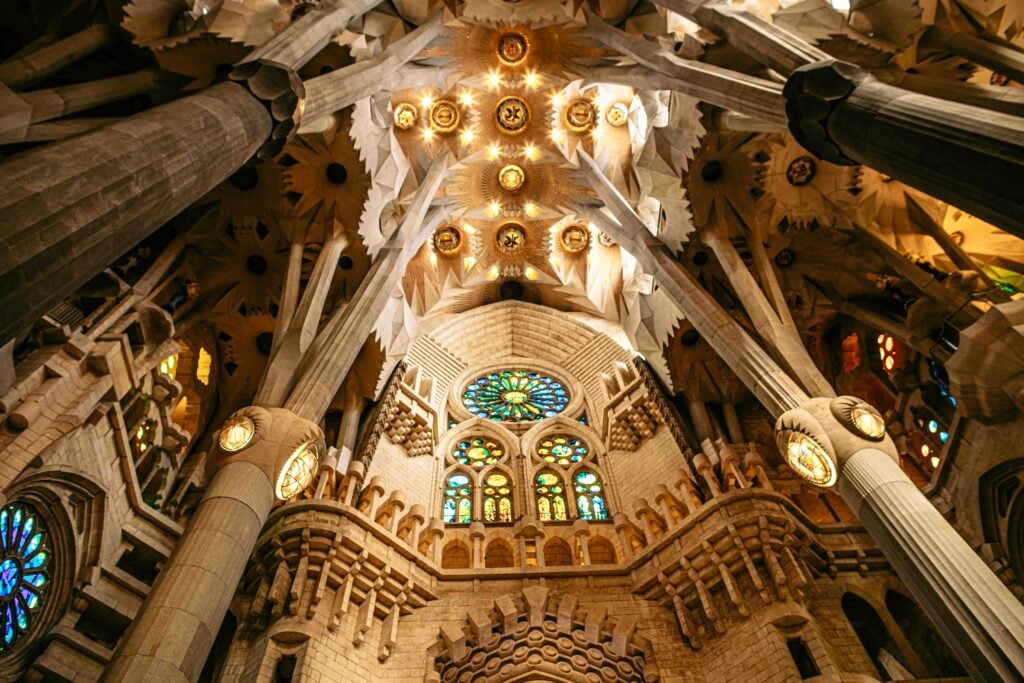
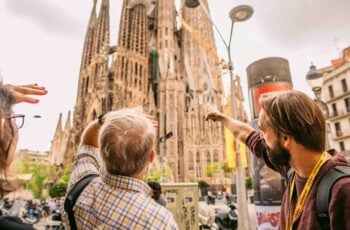
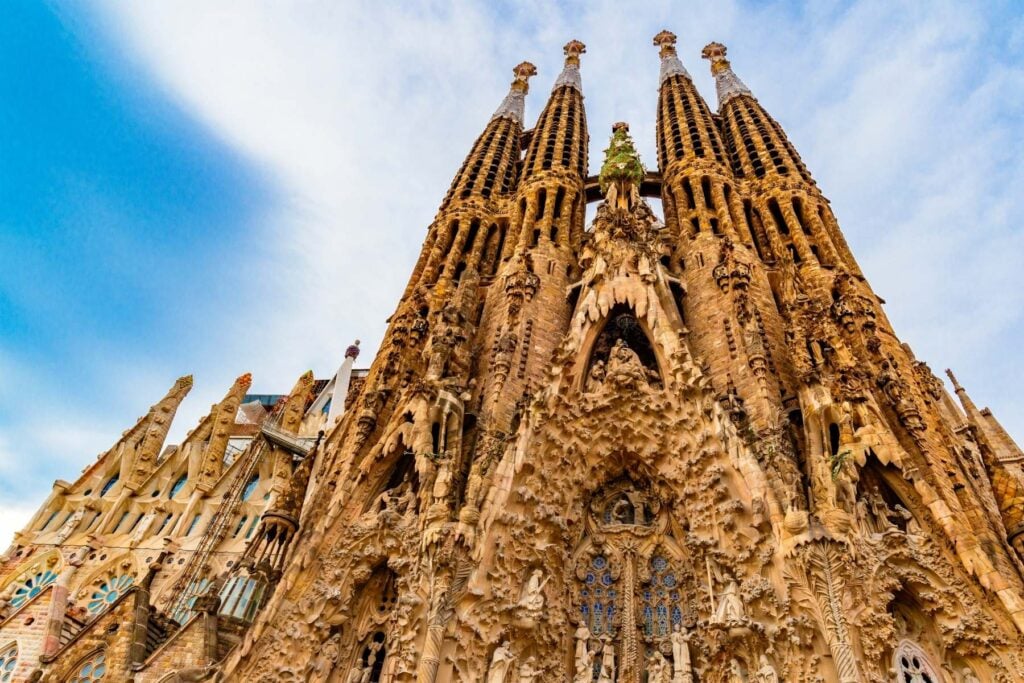
When people talk about Barcelona, the Sagrada Familia (or “the Gaudí church”) usually comes up first. It’s the pinnacle of Gaudí’s life work, and visiting it is a genuinely moving experience.
The central Tower of Jesus Christ is now complete, making it the world’s tallest church, and the Pope inaugurated it in 2026 to mark the 100th anniversary of Gaudí’s death. However, the basilica won’t be fully finished until around 2035, and completing the controversial Glory Facade will require remodeling the surrounding blocks (which the neighbors aren’t thrilled about).
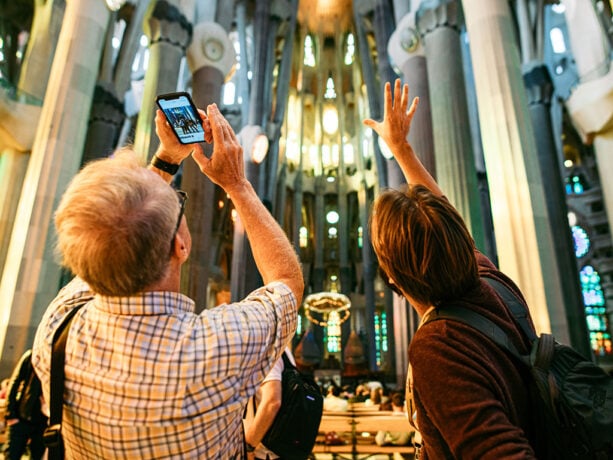
Gaudí was both a devout Catholic and endlessly inspired by nature, and it shows everywhere: animal and plant sculptures cover the facade, and a “forest” of columns holds up the structure’s immense weight.
The secret to a great Sagrada Familia visit is giving it more time than you’d expect, as there are countless tiny details that are easy to miss if you’re rushing, from the stained glass windows to the apse behind the altar, which for many visitors, is the spiritual heart of the church.
“Our highlights tour is 2 hours,” says Owen Dallison, Spain Regional Development Manager at LivTours. “When developing the tour, we experimented with different timings, and when I did this version, I was amazed by how much more complete it felt. You’re not rushed, and a great guide fills that extra time with real stories, not just facts.”
The standard entry ticket includes an audio guide, but it’s a bit like getting advice from a fortune cookie: technically informative, but not exactly tailored to you.
By contrast, a guide can slow down for a health condition, speed up for restless kids, or spend twenty extra minutes on the stained glass if that’s what you’re into. For the most personalized experience, we recommend a private tour.
Timing matters too. Early morning is cooler and quieter, and the rising sun lights up the east-facing Nativity facade in cool blue tones. Late afternoon (3–7 p.m.) is busier, but the sun shifts to the west-facing Passion facade, casting fiery reds and oranges through the basilica.
Tickets sell out weeks in advance, so plan ahead, although accredited tour companies often have more availability closer to the date.
Park Güell
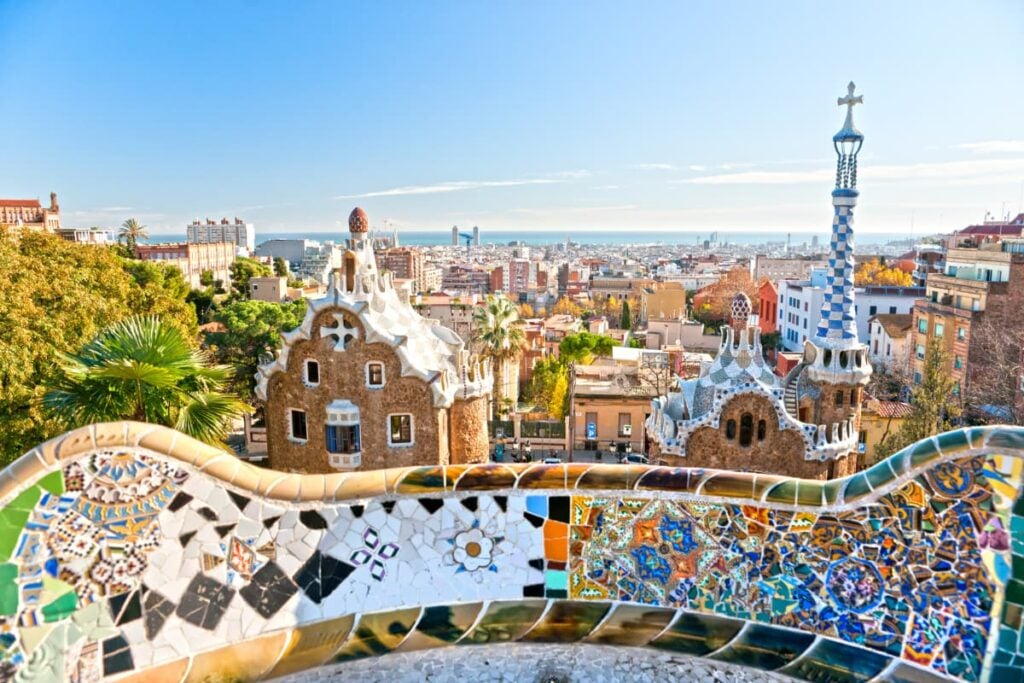
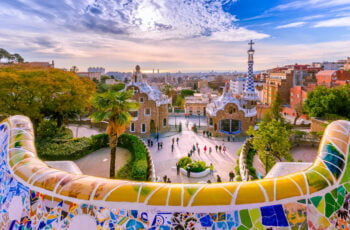
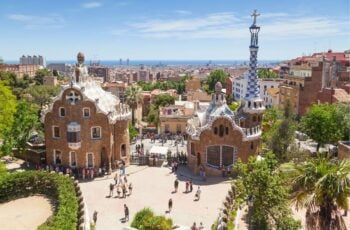
Park Güell is proof that trying and failing is better than not trying at all: Eusebi Güell’s luxury housing development sold only two of the 60 planned houses, and the project was abandoned. Gaudí moved into one of the finished houses, which is now a museum, and in 1926 it opened as a public park that’s now loved by both locals and visitors.
It’s easy to see why: it has sculpted gardens, colorful mosaics, and sweeping views across Barcelona that invite you to slow down and take it all in.
“It was designed to be somewhere to go and spend time and relax,” says Owen. “So when you’re there, do as Gaudí intended, and relax.”
Kids tend to love it, with plenty of space to run around, play hide-and-seek, and chase the odd pigeon while parents take in the history and architecture.
A few logistics catch people out here. The biggest: even though it’s a park, it’s not free to enter. You’ll still need a timed-entry ticket to visit the Monumental Zone. You can catch a glimpse of the famous salamander staircase through the gates, but the mosaic terrace and the rest of the good stuff is inside the paid zone.
It also sits up a hill, outside the city centre. If you’re reasonably fit, you can reach it on foot from Lesseps metro station in 15-20 minutes. Bus 24 runs from Plaça Catalunya and stops nearby, while lines H6 and D40 stop ten minutes’ (uphill) walk away. Uber’s coverage in Barcelona is patchy, but FreeNow tends to be reliable, and there are plenty of local taxis.
The time of day makes a huge difference to how you experience it, too. Early mornings are cooler and quieter in summer, evenings bring sunset views, and the middle of the day works well in winter, thanks to Barcelona’s roughly 300 days of sun a year and mild off-season temperatures. Afternoons in summer, on the other hand, often mean extreme heat and crowds.
With a private or small-group tour, you’ll get the stories behind the sculptures, symbols, and famous serpentine bench with a guide who knows exactly where to be and when for the best possible visit.
Casa Milà Vs. Casa Batlló Vs. Casa Vicens: Which Should You Visit?
If you have friends who’ve been to Barcelona, you’ve probably heard them say, “You should visit the “Gaudí house!” But when you started looking into it, you found yourself wondering: which one?
Usually, they’re referring to Casa Batlló, the flamboyant, colorful mansion on Passeig de Gracia that’s regularly lit up with light shows. It’s no doubt impressive, but it’s far from the last word on Gaudí architecture in Barcelona, which includes Casa Milà and Casa Vicens.
Here’s how to pick the right Gaudí house for you, before you commit to standing in line.
Casa Batlló
Best for: families, influencers, anyone who wants maximum “wow-factor”
Casa Batlló is the most visually impactful of the three. The facade is covered in Gaudí’s signature trencadís mosaic and shaped like a dragon, with bone-like balconies and a spine winding up to the rooftop, where the dragon’s arched back completes the effect.
Inside, a spiral staircase climbs through a blue-tiled light well that shifts from pale sky blue at the bottom to deep ocean blue at the top, making you feel like you’re ascending through water.
It’s gorgeous, but be prepared for crowds, especially in peak season. While tickets are available at the door, lines are long and they regularly sell out, so booking in advance is a must.
💡 Guide tip: If the lines put you off, check out Casa Amatller next door instead. “It’s always much quieter, and it’s a treasure,” says Valentina Guadagni, LivTours’ Barcelona Manager. She’s had guests message her afterwards saying they had the rooms to themselves.
Casa Milà
Best for: architecture enthusiasts, anyone interested in Catalan modernism
Casa Milà, affectionately known to locals as “La Pedrera,” (“the quarry”) thanks to its raw, undulating stone facade, sits almost opposite Casa Batlló, but is a completely different kind of Gaudí building.
The visit starts in a furnished period apartment, kitted out as it would have looked at the time, which gives you a much stronger sense of how people lived here than Casa Batlló’s more theatrical rooms.
The attic is a highlight, with its sweeping brick arches, but the real payoff is the roof. I think the best experience across the two is the Casa Milà roof,” says Owen. “It’s beautiful. Really beautiful.”
💡 Guide tip: Short on time? You can still admire Casa Batlló and Casa Milà’s facades from the outside on our private Gaudí tour.
Casa Vicens
Best for: a slower-paced visit, architecture buffs who want the full Gaudí story
If Casa Batlló and Casa Milà show you Gaudí’s buildings in his signature style, Casa Vicens shows you where it all started.
“It’s a totally different one, because it’s a very young Gaudí who hasn’t developed his unique style yet” says Valentina. “You can find the seedling to that style, but it’s not the mature Gaudí that we see everywhere.”
It’s also the calmest of the three to visit, with fewer crowds, a small garden, and a little café (selling ice cream, if you’re lucky) where you can sit in the shade and relax before moving on.
How Long Do You Need to See Gaudí’s Barcelona?
Ask LivTours’ Barcelona guides how long you need in the city, and you’ll get some version of the same answer: longer than you think.
“Take how long you think you’re going to need, and then add on at least two or three more days,” says Owen.
If you’re planning four days, consider six, as there’s simply more to Barcelona than most first-time visitors expect, and it’s one of the most common regrets we hear: guests leaving wishing they had more time.
That said, plenty of people only have a day or two, and you can still see a lot in that time. If that’s you, here’s what the guides recommend:
💡 Guide tip: Only got a half day? Our private and small-group Barcelona highlights tours let you see the best of the city without the stress.
One Day Itinerary
If you only have one day to see Gaudí’s Barcelona, prioritize Sagrada Familia and Park Güell. You could start your day at the park to beat the heat and crowds, stop for lunch on your way down the hill, then head to Sagrada Familia when the afternoon light hits the western facade.
If you’ve still got an appetite for more after that, take in a flamenco show with tapas or a sunset bike tour.
Up for a sightseeing marathon? Start your day with a Gothic Quarter walking tour and the cathedral for a dose of the city’s history before the Gaudí sites.
Just remember, though: the tighter your schedule, the less room there is for things to go wrong, and on a single day in Barcelona, there’s a lot that can.
If a single day is all you’ve got, our full-day private tour is built to solve this exact problem. You’ll get to see Sagrada Familia, Park Güell, and the Gothic Quarter all in one day without having to manage a thing.
If You Have Two Days
With a second day, you get to slow down and choose your own adventure. And in Barcelona, your options are almost endless.
A morning food tour is always a popular choice, particularly for families with kids, as it keeps them both fed and entertained at the same time.
If you’re itching for more Gaudí, you can choose from Casa Batlló, Casa Milà, or Casa Vicens, or for something completely different, head to Palau Güell, the house with an austere facade that hides its inner opulence.
If more Gaudí is starting to feel like your fifth churro con chocolate (delicious, but you can’t face a sixth), the Picasso Museum is the perfect palate cleanser.
Need to burn off a few calories from all that pa amb tomàquet (bread topped with tomato, garlic, and olive oil)? Try an e-bike tour and discover a different face of the city: Montjuïc, with its imposing castle, Olympic stadium, and stunning views of the Mediterranean.
Visiting Gaudí’s Barcelona with Kids
Gaudí’s buildings look like something out of a fairytale, and most of his work was basically designed with imagination (and short attention spans) in mind, making his buildings ideal for kids.
Casa Batlló, with its vivid images and colors, is enough to keep them entertained without much context needed, while Park Güell is the perfect place for them to burn off energy: it even has playgrounds outside the Monumental Zone.
The Sagrada Familia is a lot for them to process alone, but LivTours’ family tours are designed to turn a big fancy church into something they’ll actually enjoy.
Beyond Gaudí, the theme park at Tibidabo and the CosmoCaixa Science Museum are lifesavers for parents who need a break.
Practical Tips for Visiting Gaudí’s Barcelona
- Dress modestly for Sagrada Familia. It’s an active place of worship, so cover shoulders and knees.
- Wear comfortable shoes. Park Güell’s hill and the amount of walking between sites add up over a full day.
- Bring water and sun protection. Especially for Park Güell, which offers little shade.
- Use the T-Casual transport pass if you’re getting around by metro or bus. It covers ten journeys, is available at the airport on arrival, and is valid on airport train and bus services to the city center.
- Check accessibility in advance if needed. All the major Gaudí houses have lifts, and Sagrada Familia is accessible apart from the towers, but Park Güell can be trickier for wheelchairs or strollers.
- Book skip-the-line access where possible, particularly for Sagrada Familia and Casa Batlló, where queues can be long even with a timed ticket.
Visiting Gaudí’s Barcelona: Common Regrets and How to Avoid them
“We didn’t book timed tickets far enough in advance and now they’re sold out.” Book Sagrada Familia and Park Güell 6-8 weeks ahead in peak season, or try a tour if they’re sold out. Accredited tour operators are often allocated their own ticket blocks, so they can have availability even when direct bookings don’t.
“We thought Barcelona was ‘just Gaudí’ and missed the other modernist buildings.” Gaudí is best understood within the context of his contemporaries. Head to Palau de la Musica, Hospital de Sant Pau, or Casa Amatller to see other examples of Catalan modernism.
“We didn’t realize everything was so spread out and we would have to take public transport”. Barcelona is a compact city, but it still takes time to get around: budget at least 30-45 minutes between sites, or more if you’re with children or have mobility issues.
“We didn’t have enough time to see Barcelona properly.” Barcelona is packed with things to do that many visitors don’t realize before they arrive (and that’s before you factor in day trips like Girona, Montserrat, and the Penedés wine country). Stay longer than you think you need, or plan to come back.
Frequently Asked Questions
Is it worth visiting Sagrada Familia from the inside?
Yes, the interior is where Gaudí’s design is at its best, and you can climb the towers for unmatched views of the city.
How much time do you need to visit Sagrada Familia?
At least 1.5 hours to see it properly, and longer if you want to visit the towers or simply sit and take it in.
How long do you need to visit Park Güell?
Budget 1.5-2 hours for the visit itself, plus travel time to and from the hill. 3-4 hours total is realistic.
Which Gaudí house is better to visit?
It depends on what you’re after: Casa Batlló is the most visually dramatic, Casa Milà appeals more to architecture enthusiasts, Casa Vicens is quieter and shows Gaudí’s early evolution.
Is Casa Milà worth seeing?
Yes, particularly for the roof, considered one of the best views and architectural experiences among Gaudí’s houses.
Be Inspired by the Whimsical World of Gaudí in Barcelona
Gaudí dedicated his life to designing buildings that feel as alive as the nature that inspired them. It’s impossible not to feel moved by his creations, and you’ll understand why people fall in love with this city and keep coming back.
If you’ve got questions or want help planning your Gaudí adventure, get in touch with LivTours. We’d love to help you have the trip of your dreams.
Article Author: Victoria Peel-Yates
Expert Contributors:
- Owen Dallison | Spain Regional Development Manager at LivTours
- Valentina Guadagni | Barcelona Guide Manager at LivTours